
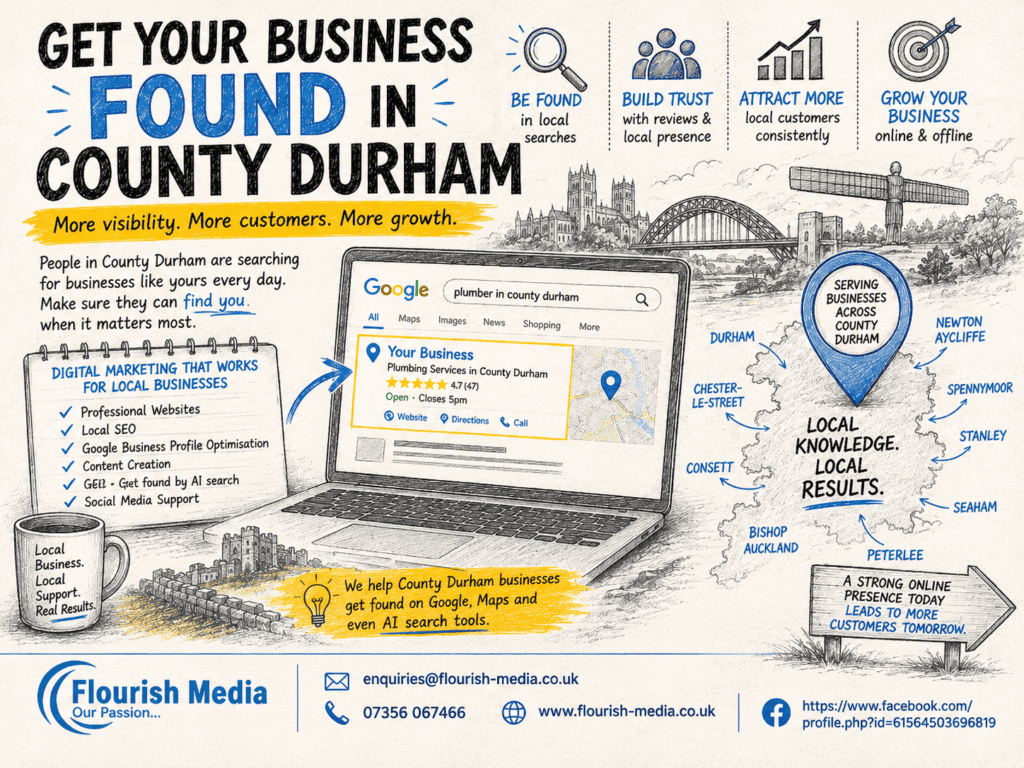
Get Your Business Found in County Durham: A Practical Guide to Digital Marketing
If you run a small business in County Durham, there is a good chance that your next customer is already looking for what you sell.
They might be searching for:
- “plumber near Durham”
- “hairdresser in Chester-le-Street”
- “dog groomer near Bishop Auckland”
- “web designer County Durham”
- “roofer in Consett”
- “best restaurant near me”
The problem is simple: If your business doesn’t appear when people search, they can’t choose you.
For small businesses, getting found online isn’t about trying to compete with huge national companies. It’s about making sure Google, potential customers and increasingly AI-powered search tools understand who you are, what you do, where you operate and why someone should choose you.
That’s where digital marketing comes in.
1. Start with a website that actually explains your business
A website shouldn’t simply look nice; it needs to answer the questions your potential customers are asking.
Imagine you run a plumbing business in Durham and someone searches:
“Emergency plumber in Durham”
They find your website.
Within a few seconds, they should be able to understand:
- You’re a plumber
- You serve Durham
- You provide emergency plumbing
- You can deal with the problem they’re experiencing
- You’re trustworthy
- They can contact you quickly
If your homepage simply says: Smith & Sons — Quality You Can Trust – that’s not particularly helpful.
Compare it with: Emergency Plumber in Durham & County Durham
Burst pipes, leaks, blocked toilets and urgent plumbing repairs. Call us today for help.
The second version immediately tells customers what you do and where you do it and it also gives search engines much clearer information.
A good website is therefore the foundation of your digital marketing.

2. Local SEO: Get found by people near you
For a small local business, SEO shouldn’t necessarily mean trying to rank nationally for enormous search terms.
You probably don’t need to rank for:
“Plumber”
You need to rank for searches that could actually bring you a customer.
For example:
- Plumber Durham
- Plumber Chester-le-Street
- Emergency plumber Bishop Auckland
- Boiler repair Newton Aycliffe
- Electrician Consett
- Roofer Stanley
- Joiner Spennymoor
That’s local SEO.
Google says local results are primarily influenced by relevance, distance and prominence. It also recommends keeping your business information complete and accurate and responding to customer reviews.
That means a small County Durham business can compete by being highly relevant to its local market.
Read Google’s SEO Starter Guide to learn how businesses can improve their visibility in Google search results through useful website content, page structure, descriptive titles and good SEO practices.
3. Your Google Business Profile matters
If you’ve ever searched for a business on Google and seen a map with several businesses underneath it, you’ve seen Google Business Profiles in action.
For example, someone searching:
“Indian restaurant Durham”
may see restaurants, their locations, reviews, opening times, photographs and links to their websites.
For a local business, this is incredibly valuable.
A hairdresser in Seaham, for example, could appear when someone searches for:
“hairdressers near Seaham”
A dog groomer in Peterlee could potentially appear for:
“dog groomer Peterlee”
A garage in Newton Aycliffe could be discovered by someone searching:
“MOT garage near Newton Aycliffe”
Google describes a Business Profile as essentially an online shopfront on Google Search and Maps. But simply having a profile isn’t enough; it should be accurate, complete and regularly maintained.
That means having the correct:
- Business name
- Category
- Phone number
- Website
- Opening hours
- Service area
- Photos
- Services
- Customer reviews
For an easy to understand guide, read How to Set Up a Google Business Profile in the UK.
Google also recommends choosing the most specific relevant business category rather than using categories simply as keywords. Read Google’s Local Ranking Guidance to understand the three main factors behind local search rankings: relevance, distance and prominence.
4. Reviews can make a huge difference
Imagine you’re looking for a local electrician.
You find two businesses.
Electrician A
★★★★★ 47 reviews
Electrician B
★★★★★ 3 reviews
Both websites look reasonably good, but who are you more likely to contact?
Reviews don’t just provide social proof to customers. Google says reviews and positive ratings can contribute to local prominence and that is why getting genuine reviews should be part of your digital marketing strategy.
And don’t just collect them, respond to them.
A simple:
“Thanks very much for the review, John. Glad we could get your boiler sorted.”
feels much more human than ignoring every review you’ve received.
Here’s one of the easiest opportunities for small businesses.

5. Create content around the questions your customers ask
Think about the questions customers ask you every week.
If you’re a roofer, they might ask:
“How much does it cost to repair a leaking roof?”
If you’re an accountant:
“When does a small business need to register for VAT?”
If you’re a wedding photographer:
“How far in advance should I book a wedding photographer?”
If you’re a landscaper:
“How much does garden landscaping cost in County Durham?”
If you’re a dog groomer:
“How often should I get my dog groomed?”
Those questions can become website content.
You could create a blog article answering each one. This gives your website more useful information and creates additional opportunities for people to discover your business through search.
Instead of constantly saying: “We provide excellent service.”, you’re actually helping people.
And helpful businesses are much easier to discover than businesses whose websites contain nothing but sales messages.
6. Don’t try to hide that you’re local
One mistake we see small businesses make is trying to sound bigger than they are.
They remove all references to their local area because they think it makes them look more professional. We’d argue the opposite.
If you serve County Durham, say so.
Talk about the areas you genuinely serve, for example, a landscaping company could have content covering:
- Durham
- Chester-le-Street
- Consett
- Stanley
- Bishop Auckland
- Spennymoor
- Newton Aycliffe
A photographer could explain that they cover weddings across County Durham and nearby areas.
A mobile mechanic could explain which towns they travel to.
A cleaner could explain which areas they cover.
This gives potential customers confidence that you’re actually available to them and it also provides useful local context for search engines. Read about How to Promote your Business in County Durham.
7. Your social media supports your website
Facebook isn’t necessarily going to replace your website, but it works better when the two support each other.
Imagine you’re a local café in Barnard Castle.
You post a photograph of your new breakfast menu on Facebook.
Instead of simply saying: “New menu available!”, you could say:
“New breakfast menu! We’ve added a few new favourites this week. If you’re heading into Barnard Castle this weekend, pop in and give them a try. See the full menu on our website.”
Now Facebook is helping people discover your business and sending interested people to your website.
The same applies to a beauty salon in Durham, a gym in Consett, a florist in Bishop Auckland or a local estate agent in Chester-le-Street:
- Your social media creates attention.
- Your website gives people somewhere to go next.
Demonstrating that successful social media marketing isn’t simply about posting regularly. It requires a plan, an understanding of your audience and content that gives people a reason to engage. Read the GOV.UK Social Media Playbook for more advice.
8. Think beyond Google: GEO and AI search
There’s another reason your website needs to contain useful, clear information.
People are increasingly using AI-powered tools to discover information and businesses.
Someone might ask:
“Can you recommend a web designer for a small business in County Durham?”
Or:
“What are some good wedding photographers around Durham?”
Or:
“Find me a reliable local roofer near Bishop Auckland.”
This is where GEO — Generative Engine Optimisation — comes into the conversation.
The idea isn’t simply to stuff your website with keywords and hope an AI recommends you, it’s about making your business easy to understand:
- Who are you?
- What do you offer?
- Where do you operate?
- Who are your customers?
- What questions do you answer?
- What evidence demonstrates your experience?
- What other reputable websites mention you?
The better your overall online presence communicates those things, the more useful your information becomes to search engines and AI systems. And importantly, GEO doesn’t replace SEO.
Good SEO foundations are still important.
Think of it this way:
- SEO helps people find your website.
- GEO helps make your business easier for AI-powered search to understand.
Neither should involve making unrealistic promises about guaranteed recommendations or rankings.
9. Don’t forget the human being behind the search
There’s one thing that sometimes gets lost in digital marketing; You’re not marketing to Google, you’re marketing to people.
Consider a customer searching for a garage, they don’t really care about your SEO strategy.
They care about:
“Can you fix my car?”
A customer looking for a plumber wants:
“Can you stop my bathroom flooding?”
Someone looking for an accountant wants:
“Can you help me sort my accounts?”
Someone looking for a website designer wants:
“Can you build me a website without making this complicated?”
Your website needs to answer those questions quickly.
That’s why good digital marketing isn’t about filling a website with meaningless keywords.
It’s about being useful, relevant and trustworthy.
10. So, how do you get your County Durham business found?
If you’re a small business owner, I’d start with these basics:
✅ Build a professional website
Make it clear what you do, who you help and where you operate.
✅ Optimise your website for local searches
Don’t just target broad terms. Think about the actual searches your customers make.
✅ Claim and maintain your Google Business Profile
Keep your information accurate and complete.
✅ Get genuine customer reviews
And respond to them.
✅ Create useful content
Answer the questions customers are already asking.
✅ Use social media
Share useful information, examples, projects, photographs and customer stories — and send interested people back to your website.
✅ Start thinking about GEO
Make your website clear and informative enough that both search engines and AI-powered systems can understand your business.
Your next County Durham customer is already searching
Whether you’re a plumber in Durham, hairdresser in Seaham, electrician in Consett, accountant in Bishop Auckland, roofer in Stanley, photographer in Chester-le-Street, landscaper in Spennymoor, garage in Newton Aycliffe, restaurant in Barnard Castle, dog groomer in Peterlee, florist in Shildon or a local tradesperson anywhere across County Durham, people are searching for businesses like yours.
The question isn’t whether people are searching.
It’s:
Can they find you?
And when they do find you, does your website give them a reason to get in touch?
That’s where good web design, local SEO, useful content and GEO come together.
You don’t need to become a digital marketing expert yourself, you need an online presence that does the job for you.
If your business is in County Durham and you’re not sure how easy you are to find online, let’s take a look.
Message Flourish Media for a free chat about your website, SEO and online visibility.
📧 enquiries@flourish-media.co.uk
📞 07356 067466
🌐 www.flourish-media.co.uk
Get found. Get trusted. Get chosen.

