
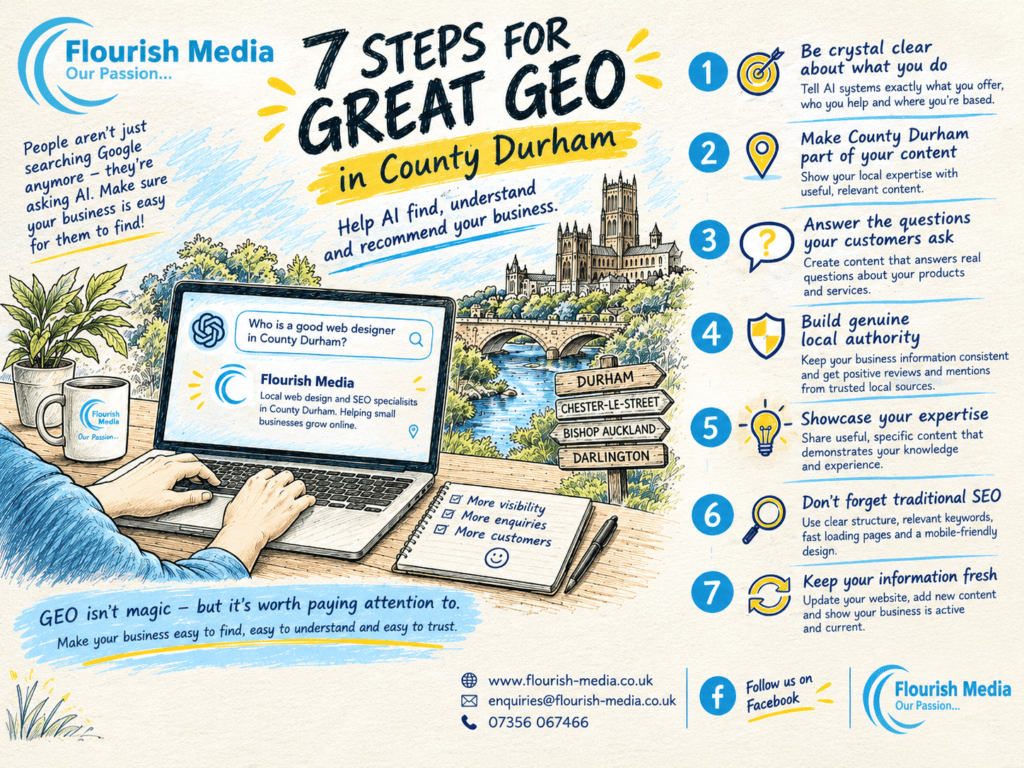
7 Steps for Great GEO in County Durham
If you run a small business in County Durham, you probably already know that being visible online matters. But the way people find businesses is changing.
People aren’t just typing a search into Google anymore. They’re increasingly asking AI tools questions such as “Who is a good plumber near Durham?”, “What’s the best wedding photographer in County Durham?” or “Can you recommend a web designer for a small business in the North East?”
That’s where GEO comes in.
GEO stands for Generative Engine Optimisation. In simple terms, this means creating and structuring your online presence so that AI-powered search systems can better understand your business, what you do, where you operate and who you help.
It doesn’t replace traditional SEO, instead, SEO helps you get found in search, while GEO helps make your business easier for AI systems to understand.
So, how can a County Durham business get started?
1. Be crystal clear about what you do
It sounds obvious, but your website needs to make your business incredibly easy to understand.
Don’t simply say:
“Welcome to our website. We provide quality solutions for our customers.”
That’s vague. Instead, say exactly what you offer and where.
For example:
“We provide professional plumbing services to homes and businesses across Durham, Chester-le-Street and surrounding County Durham areas.”
AI systems need context. The clearer you are about your services, audience and location, the easier it is for them to understand your business.
2. Make County Durham part of your content
If you want local customers, don’t hide your location.
Create useful content that naturally references the areas you serve, but don’t simply stuff place names onto a page. Read ‘Tips to improve your local ranking on Google.’
Write genuinely useful local content – a roofer might create:
“Common roofing problems we see in homes across County Durham.”
A wedding photographer could write:
“5 beautiful wedding venues in County Durham.”
This gives search engines — and AI systems — much more information about your local expertise.

3. Answer the questions your customers actually ask
One of the easiest ways to improve your GEO is to stop writing only about your business and start answering your customers’ questions.
Think about the questions people ask before buying, for example:
“How much does a new website cost for a small business in County Durham?”
“How often should I service my boiler?”
“What should I look for in a local accountant?”
Create useful pages or blog posts answering those questions clearly. This gives AI systems something useful to understand and potentially draw upon when answering related questions.
4. Build genuine local authority
AI doesn’t just need to know what your business does. It needs context that helps establish whether you’re a credible source. Make sure your business information is consistent across your website and other reputable online platforms.
Your business name, services, location and contact information should match wherever possible – for more information on how to set up a Google Business profile, read this.
Local directories, professional organisations, local publications, partnerships and genuine customer reviews can also help build a stronger overall online presence.
The goal isn’t to collect hundreds of random links. It’s to build real evidence that your business exists, operates locally and knows what it’s talking about.
5. Create content that demonstrates expertise
Don’t just tell people you’re an expert – Show them.
If you’re a local electrician, explain common electrical problems.
If you’re a builder, discuss planning considerations.
If you’re a hairdresser, answer questions about maintaining different hair types.
If you’re a web designer, explain how local businesses can improve their websites.
Useful, specific content gives your business depth; for more advice on this, read ‘Creating helpful, reliable, people-first content‘. Importantly, specific content also gives AI systems more information from which to understand your expertise.
6. Don’t forget traditional SEO
Here’s an important point:
GEO isn’t a replacement for SEO.
Your website still needs the basics.
That means:
- Clear page titles
- Useful headings
- Relevant keywords
- Fast loading pages
- Mobile-friendly design
- Internal links
- Well-written content: see this Search Engine Optimization (SEO) Starter Guide
- Properly structured information
- Strong local SEO
Think of SEO and GEO as working together.
SEO helps search engines find and understand your website – read this blog about how SEO can get your organisation noticed. GEO builds on that foundation by making your expertise and information easier for generative search systems to interpret.
7. Keep your information fresh
Your online presence shouldn’t be something you build once and forget.
Businesses and services change, areas served change, prices change. New projects happen. New reviews arrive.
Keep your website and business information up to date by adding useful articles, updating old content, publishing examples of your work and answering new customer questions. The more accurate and useful your online presence is, the stronger your overall digital footprint becomes.
GEO isn’t magic — but it’s worth paying attention to
There’s no secret button that guarantees ChatGPT, Google or another AI system will recommend your business, but the principle is straightforward:
Make your business easy to find, easy to understand and easy to trust.
And for a small business in County Durham, that means combining a professional website, strong local SEO, useful content and a clear demonstration of your expertise. That’s where good GEO starts.
Want a website that’s built with SEO and GEO in mind?
Flourish Media can help.
📧 enquiries@flourish-media.co.uk
📞 07356 067466
📘 Follow Flourish Media on Facebook
Get in touch for a chat about your website.

